Milk aisle labels have become a bit of a word salad, haven’t they? Lactose-free, dairy-free, plant-based, vegan, non-dairy… all sitting next to each other looking as though they mean roughly the same thing.
They don’t. And if you have IBS, lactose intolerance or a milk allergy, understanding the difference actually matters. So before you decide dairy is the enemy and ban everything remotely creamy from your kitchen, let’s sort out what these labels really mean.
What does lactose-free actually mean?
Lactose is the natural sugar found in milk from animals such as cows, goats and sheep. To digest it properly, your small intestine produces an enzyme called lactase, which breaks lactose down into two simpler sugars your body can absorb.
And producing less lactase after childhood is actually very common. In fact, around 68% of the world’s population has some degree of lactose malabsorption, meaning their ability to digest lactose reduces after infancy. Plenty of people and populations around the world also eat little or no dairy and can still meet their calcium needs through other foods. Dairy can certainly be a useful source of calcium, but it isn’t the only place calcium lives.
Some people do not produce enough lactase. When lactose is not properly digested, it travels further through the gut where bacteria ferment it, which can lead to bloating, wind, cramping and diarrhoea. Not exactly the relaxing coffee break you had in mind.
Lactose-free dairy is still dairy. It normally starts as ordinary cow’s milk, yoghurt, cream or another milk product, but lactase is added so the lactose is broken down before you eat or drink it. The proteins, fat, calcium and other nutrients are still there.
You may also notice lactose-free milk tastes slightly sweeter. Nobody has secretly tipped sugar into it. The sugars produced when lactose is broken down simply taste sweeter on your tongue.
So what does dairy-free mean?
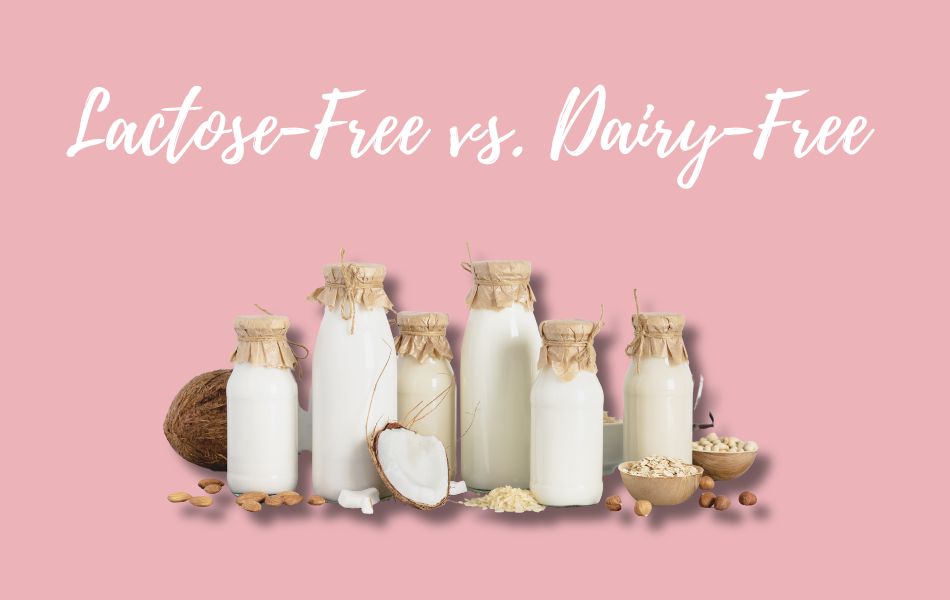
Dairy-free means there should be no milk or milk-derived ingredients in the product at all. Instead, you might see alternatives made from oats, almonds, soy, coconut, cashews, rice or peas.
A genuinely dairy-free product will also be lactose-free because lactose comes from milk. But the reverse is NOT true: lactose-free does not mean dairy-free.
Think of it this way. Lactose-free cow’s milk is still cow’s milk wearing slightly different trousers. Oat milk has left the cow out of the arrangement completely.
And that distinction is particularly important if you are avoiding dairy because of a milk allergy rather than lactose intolerance.
Lactose intolerance and milk allergy are NOT the same thing
Lactose intolerance is a digestive problem. Your body does not make enough lactase to comfortably digest the lactose you eat, so symptoms are usually things such as bloating, wind, cramps, loose stools and sometimes nausea.
A milk allergy is different. It involves the immune system reacting to proteins in milk, most commonly casein or whey. Symptoms can include hives, swelling, vomiting, wheezing and breathing difficulties, and a severe reaction can cause anaphylaxis.
So if somebody has a diagnosed milk allergy, lactose-free milk is NOT a suitable substitute. The lactose may have been broken down, but the milk proteins are still sitting there quite happily.
This is why I do not like seeing food allergy and food intolerance treated as interchangeable terms. One involves digestion; the other can involve a serious immune reaction, and the advice needs to reflect that. If you are unsure about the difference, read IBS and Food Intolerances vs Allergies for a clearer explanation of what is actually happening in the body.
What does this mean if you have IBS?
This is where a lot of unnecessary restriction starts.
Having IBS does not automatically mean you need to remove dairy. Lactose is a FODMAP, which means it can be poorly absorbed and trigger symptoms in some people with IBS, but “dairy” itself is not a FODMAP category.
Some dairy foods contain more lactose than others, while some cheeses are naturally very low in lactose. Lactose-free milk and yoghurt may also be suitable for people who react to lactose but are otherwise able to tolerate dairy.
So if you feel better after removing ordinary milk, that is useful information, but it does not prove that every dairy food is a problem. It may be the lactose. It may be the amount you had. It may be something else in the meal entirely.
And if you remove milk, yoghurt, cheese, wheat, onions, garlic, caffeine and half the fruit bowl all at once, then feel better, congratulations… we now have absolutely no idea which change helped.
You might tolerate some lactose
Lactose intolerance is not always all or nothing. Some people can manage a small amount without any difficulty but develop symptoms after a larger portion.
You might tolerate a little milk in tea but not a huge milky coffee. A small amount of yoghurt may be fine while ice cream causes havoc. This is why the amount matters just as much as the food itself.
Rather than automatically deciding “I can’t have dairy”, look at the pattern. What did you eat? How much? What happened afterwards? Does the same thing happen every time? And does a lactose-free version cause the same problem?
Those details are far more useful than giving an entire food group a criminal record based on one dodgy afternoon.
Lactose intolerance can sometimes be temporary
Lactase is produced in the small intestine, so anything that irritates or damages that area can sometimes reduce your ability to digest lactose for a while. This can happen with some digestive conditions, after intestinal illness or surgery, and during certain medical treatments.
That means somebody may tolerate lactose perfectly well at one point and struggle with it later. It does not automatically mean dairy needs to disappear forever.
If your tolerance has suddenly changed, your symptoms are persistent or your diet is becoming smaller and smaller, speak to an appropriate healthcare professional rather than trying to diagnose the cause yourself.
Is dairy-free healthier?
Not automatically.
Lactose-free cow’s milk is nutritionally very similar to ordinary cow’s milk. It still provides protein, calcium and other nutrients because breaking down lactose does not remove the rest of the milk.
Dairy-free alternatives vary enormously. Soy milk can provide a reasonable amount of protein, while some almond, rice, oat or coconut drinks contain much less. Calcium, vitamin D and vitamin B12 may be added, but the amounts differ between products and brands.
Then there is the ingredients list. Some dairy-free products are very simple. Others contain added oils, gums, stabilisers, flavourings or sugar to create the texture and taste people expect from dairy.
That does not automatically make them “bad”. It simply means dairy-free is not a magic health label. Turn the packet over and look at what you are actually buying.
Be careful with labels if you have a milk allergy
Words such as lactose-free, dairy-free, vegan and non-dairy can sound reassuring, but they do not all mean exactly the same thing on every product or in every country. In the US in particular, something labelled “non-dairy” may still contain milk-derived ingredients such as caseinates.
If you have a diagnosed milk allergy, do not rely on the big friendly claim on the front. Read the ingredients and allergen information carefully and look for milk and milk-derived ingredients such as whey, casein and caseinates.
Recipes change too, so check the CURRENT packet even if you have bought the product before. Yes, reading labels is a faff. Anaphylaxis is considerably more inconvenient.
If you want a more detailed look at what food labels actually mean, including the differences between UK and US labelling rules, read UK and USA Food Labelling: Things to Look Out for With IBS.
So which one should you choose?
If lactose appears to be your problem, lactose-free dairy may allow you to keep foods you enjoy without the symptoms you get from higher-lactose products. It can also make it easier to maintain protein and calcium intake without replacing everything with plant alternatives.
If you have a milk allergy, lactose-free products are not enough because they still contain milk proteins. You need products that are genuinely free from milk and appropriate for your allergy.
If you prefer dairy-free products, that is absolutely your choice, but check the nutrition information rather than assuming one plant milk is the same as another. Look at protein, calcium, vitamin D, added sugar and the overall ingredients list.
And if you have IBS but do not actually know whether lactose is causing your symptoms, I would rather you investigate properly than remove dairy indefinitely “just in case”.
Please don’t make your diet smaller than it needs to be
One of the biggest problems with IBS is that people can gradually end up with fewer and fewer foods because every symptom gets blamed on the last thing they ate.
Food can absolutely affect IBS, and lactose can absolutely be a trigger. But digestive symptoms are not always caused by one ingredient, and more restriction is not automatically better.
The useful question is not “Should everybody with IBS avoid dairy?” It is “What does YOUR gut actually tolerate, in what amount, and what happens when we test it properly?”
That is a much less dramatic answer than banning an entire aisle of the supermarket, I know. It is also far more useful.
Want help working out what your gut is actually reacting to?
If you are constantly removing foods, swapping products and still cannot work out why your gut is playing up, book a Free Gut Health Call. We can talk through your symptoms, what you have already tried and whether The IBS Freedom Method could help you understand your triggers and rebuild confidence around food.
No random banned-food list and no assuming dairy is guilty because your stomach once objected to a milkshake. Just a proper look at the wider picture and what your digestive system may actually need.
About Helen Jane
Helen Jane is a qualified Nutritional Therapist and IBS Coach with over 10 years of experience helping people reduce IBS, bloating, food intolerances, digestive discomfort and low energy through practical nutrition and lifestyle changes. As founder of Your IBS Freedom and creator of The IBS Freedom Method, she specialises in helping people improve gut health naturally using food as medicine without restrictive fad diets or unnecessary overwhelm, supporting clients across the UK, Europe and the USA. Read client success stories and reviews here
Disclaimer
This blog is for educational purposes only and is not a substitute for personalised medical advice, diagnosis or treatment from your GP, allergy specialist or other qualified healthcare professional. Milk allergy can cause severe and potentially life-threatening reactions. If you suspect a milk allergy, seek appropriate medical assessment. If somebody is experiencing signs of anaphylaxis, use their prescribed adrenaline auto-injector if available and call the emergency services immediately.
