
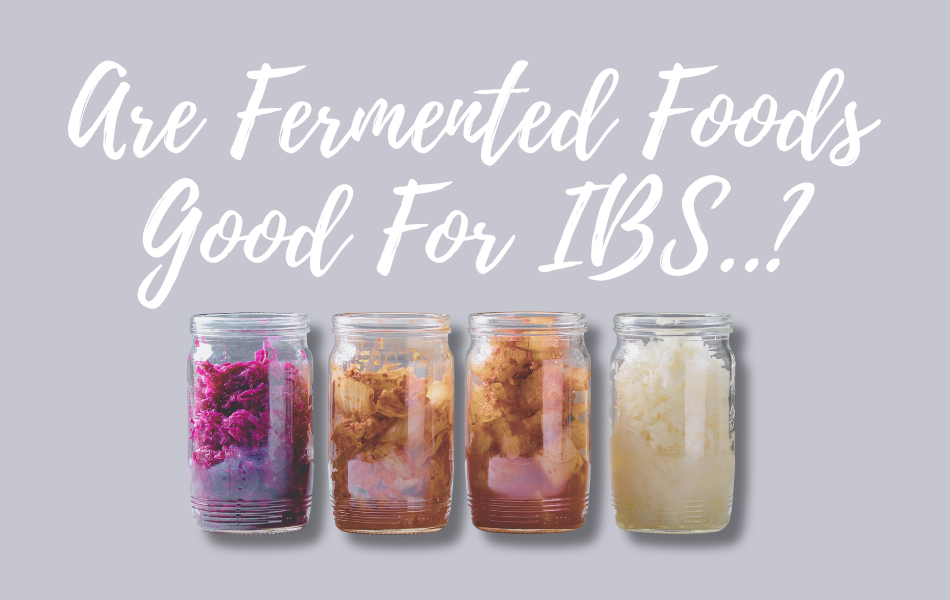
Here’s What You Need to Know
If you’ve been looking for ways to improve your IBS, you’ve probably come across the same advice over and over again.
“Eat more fermented foods.”
- Kimchi.
- Kefir.
- Kombucha.
- Sauerkraut.
- Yoghurt.
They’re everywhere…
Open social media and you’ll find people talking about the amazing benefits of fermented foods. Supermarkets have bigger selections than ever before, and many people are even making their own at home.
Apparently, they’re the secret to better gut health. And to be fair… They can be incredibly healthy.
But here’s the thing…
Healthy doesn’t always mean IBS-friendly. Because while one person feels fantastic after eating fermented foods…
This is actually one of the questions I get asked all the time by my clients, which is exactly why I decided to write this article. So many people hear that fermented foods are ‘good for your gut’ and assume they should simply eat more of them. Unfortunately, IBS is rarely that straightforward. What works brilliantly for one person can leave someone else feeling bloated, uncomfortable and wondering what on earth went wrong.
Someone else ends up bloated, uncomfortable and wondering why they ever thought that kimchi was a good idea.
So, are fermented foods good for IBS? The honest answer is… Sometimes.
If you’re feeling overwhelmed by all the conflicting advice online, you can always book a Free Gut Health Call and I’ll help you work out which foods are worth trying for your own IBS.
Why Are Fermented Foods Considered Good For Gut Health?
Fermented foods are made by allowing beneficial bacteria or yeast to naturally break down sugars in food. This process creates probiotics, which are live microorganisms that may help support your gut microbiome.
A healthy gut microbiome has been linked to:
- Better digestion
- A stronger gut lining
- Improved immune function
- Reduced inflammation
- Better bowel regularity
If you’d like to understand more about how your gut bacteria affect digestion, I’ve written another article explaining the Gut Microbiome and IBS in more detail. Since many people with IBS have changes in their gut bacteria, it’s understandable why fermented foods often get recommended.
But here’s the important part…
Not every fermented food contains the same bacteria. And more importantly…
Not every IBS gut responds the same way.
Over the years, one of the biggest things I’ve learnt from working with my clients is that there isn’t one ‘IBS diet’ that suits everyone. One client might thrive on a particular food, whilst another reacts to exactly the same thing. That’s why I’m far more interested in how your gut responds than following the latest gut health trend.
Why Fermented Foods Can Make IBS Worse
This is where things get a little more complicated. Although fermented foods contain probiotics, many also contain ingredients that are common IBS triggers.
These can include:
- Garlic and onion (high in FODMAPs)
- Chilli and spicy seasonings
- Histamine produced during fermentation
- Carbonation
- Acidity
- Lactose in some dairy products
So while one person happily enjoys kimchi every week…
Someone else may spend the next few hours regretting every life choice that led to those three forkfuls. IBS really does like to keep us on our toes!
Let’s Talk About The Most Popular Fermented Foods
Kimchi
Kimchi is packed with beneficial bacteria thanks to the fermentation process. It also contains plenty of vitamins, fiber and antioxidants.
Sounds perfect… Until you remember what’s usually in it.
Traditional kimchi often contains garlic and onion, both of which are high in FODMAPs. If you’re not sure what that means, you might like to read my guide to the Low FODMAP Diet and IBS first.
For someone with IBS, especially if you follow a low FODMAP diet or have diarrhoea-predominant IBS (IBS-D)… those ingredients can easily trigger bloating, abdominal pain or urgent trips to the toilet.
One client of mine enjoys a couple of forkfuls of kimchi once or twice a week and finds it really helps to keep their bowels behaving. Another couldn’t tolerate it at all because of the garlic and chilli. The fermented food itself wasn’t necessarily the problem… it was everything else that came with it.
Some people tolerate small amounts perfectly well. Others don’t.
Kombucha
Kombucha is fermented tea that’s become incredibly popular over the last few years. It contains probiotics, organic acids and antioxidants, making it sound like the ultimate gut-friendly drink.
However… It’s also fizzy. It’s acidic. And many commercial brands contain residual sugars or fruit juices that can be high in FODMAPs.
For people with IBS, that combination can contribute to:
- Gas
- Bloating
- Abdominal discomfort
- Reflux
If you’d like to try kombucha, start with a very small serving rather than a full bottle. Your gut will soon let you know what it thinks.
Kefir
Out of all the fermented foods, kefir has some of the strongest evidence behind it for supporting gut health. Research suggests it may help improve the balance of beneficial bacteria in the gut, and some studies have shown improvements in overall IBS symptoms.
That said… Milk kefir still contains lactose.
If you’re lactose intolerant or sensitive to dairy, it may not be the best option. Water kefir may be easier to tolerate for some people.
I’ve certainly seen this in practice. One of my clients swears by a small glass of water kefir each morning and says it helps to keep their digestion ticking along nicely. Others haven’t tolerated it at all. Again, this is why listening to your own body is so important rather than assuming something is right simply because it’s considered healthy.
As with any new food, introduce it slowly and monitor your symptoms.
Sauerkraut
Sauerkraut is simply fermented cabbage. Raw, traditionally fermented versions contain live bacteria that may help support a healthy gut microbiome.
However, cabbage naturally contains FODMAPs, and fermentation also increases histamine levels.
That means some people with IBS tolerate it beautifully…
While others experience bloating, cramping or digestive discomfort.
If you’d like to give it a try, begin with just one teaspoon and gradually increase to around two tablespoons, provided your gut is happy.
Yoghurt
Yoghurt is probably the fermented food most people are familiar with. Many natural yoghurts contain live cultures that can help support a healthy gut microbiome. They’re also a great source of protein and calcium.
However… Not all yoghurts are the same.
Some are packed with added sugar, flavourings or artificial sweeteners that may upset sensitive stomachs.
Lactose can also be a problem for some people with IBS. Although fermentation reduces the amount of lactose, it doesn’t remove it completely.
If you know dairy doesn’t agree with you, lactose-free yoghurt may be a better choice.
The important thing is paying attention to how your body responds
This is exactly why nutrition can be so confusing. Social media loves simple answers, but IBS rarely gives us one. I often tell my clients that your gut doesn’t care what’s trending on Instagram – it only cares about what it can comfortably digest.
If you’re tired of guessing which foods suit your body, my Your Diet Makeover program takes an in-depth look at your diet and helps identify exactly what’s working for you… and what isn’t.
So Should You Eat Fermented Foods?
With IBS, there isn’t a one-size-fits-all answer.
If only there were! It would certainly make my job easier! But the reality is that IBS is incredibly individual. The aim isn’t to avoid foods forever. It’s to understand your own body well enough that you can enjoy as much variety as possible without triggering symptoms.
The best approach is to become curious about your gut.
Ask yourself:
- Do I feel better after eating this?
- Do my symptoms get worse?
- Am I eating a sensible portion?
- Does this food contain ingredients I already know don’t agree with me?
One person’s miracle food can easily become someone else’s biggest trigger.
That’s why I always encourage my clients to become curious about their gut rather than frightened of food. Your digestive system is constantly giving you clues – once you know how to listen to it.
What To Do Next
You’ve probably realised by now that fermented foods aren’t simply “good” or “bad” for IBS. The important thing is understanding what works for your gut.
If you’re feeling confused about which foods you should and shouldn’t be eating, you’re certainly not alone. It’s something I help people with every single week.
During your Free Gut Health Call, we’ll chat about your symptoms, your diet, your health history and the things you’ve already tried. As a Nutritional Therapist specialising in IBS and gut health, I’ll help you start piecing together the clues so you can stop guessing and start understanding what your gut has been trying to tell you.
The truth is, there isn’t one fermented food that’s perfect for everyone, and there isn’t one IBS diet that suits every person either. Every gut is different, which means the best approach is one that’s tailored to you. That’s exactly what we’ll start to uncover together.
Learn More
Want to learn more about the connection between IBS and probiotic foods? Explore these trusted resources:
- Can Kombucha Help With IBS? What the Science Says
- Is Sauerkraut Bad for IBS or Can It Help?
- Is yogurt good for IBS? What to look for in yogurt products and what to avoid
- Is kimchi good for IBS?
- Can kefir help with IBS?
About Helen Jane
Helen Jane is a qualified Nutritional Therapist and IBS Coach with over 10 years of experience helping people reduce IBS, bloating, food intolerances, digestive discomfort, and low energy through practical nutrition and lifestyle changes.
As founder of Your IBS Freedom, she specialises in helping people improve gut health naturally using food as medicine – without restrictive fad diets or unnecessary overwhelm, supporting clients across the UK, Europe, and the USA.
Read client success stories and reviews here:
https://www.youribsfreedom.com/reviews/
Disclaimer
This blog is for educational purposes only and is not a substitute for personalised medical advice, diagnosis, or treatment from your GP or healthcare professional.
KEY REFERENCES
BiologyInsights Team. (2025, December 7). Can Kombucha Help With IBS? What the Science Says – Biology Insights. Biology Insights. https://biologyinsights.com/can-kombucha-help-with-ibs-what-the-science-says/
BiologyInsights Team. (2025, December 10). Is Sauerkraut Bad for IBS or Can It Help? – Biology Insights. Biology Insights.
https://biologyinsights.com/is-sauerkraut-bad-for-ibs-or-can-it-help/
Cafasso, J. (2017, September 4). Is yogurt good for IBS? What to look for in yogurt products and what to avoid. Healthline.
https://www.healthline.com/health/yogurt-and-ibs
Conlon, D. S. a. M. (2026, July 15). Fermenting food is nothing new, but gut health is taking the spotlight – Los Angeles Times. https://www.latimes.com/science/story/2026-07-14/fermenting-food-is-nothing-new-but-gut-health-is-taking-spotlight
Lam, C. (2025, September 17). Is kimchi good for IBS? Food Blog Alliance.https://foodblogalliance.com/is-kimchi-good-for-ibs/
Lillis, C. (2025, June 9). Can kefir help with IBS? https://www.medicalnewstoday.com/articles/kefir-and-irritable-bowel-syndrome
