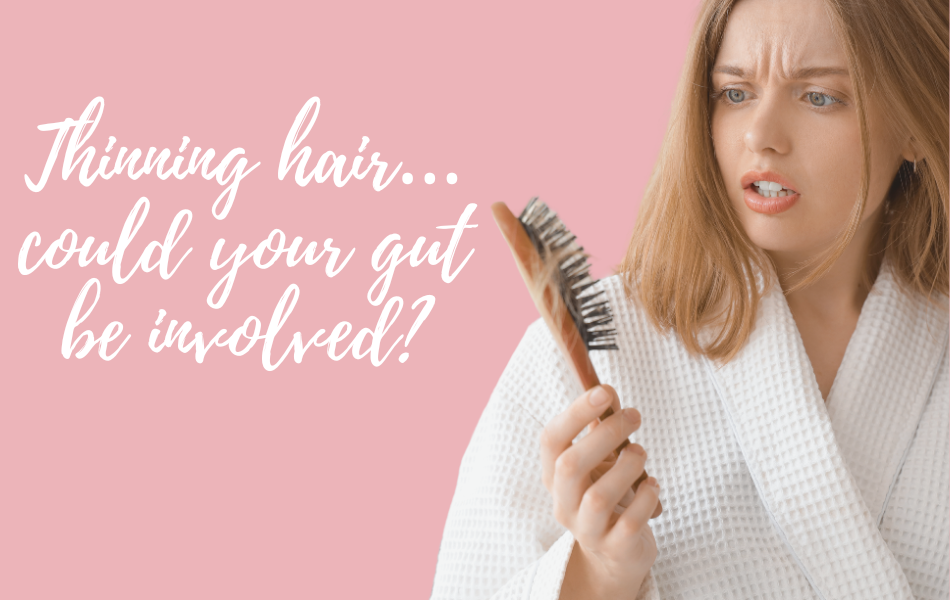
Losing some hair every day is perfectly normal. But when you’re noticing considerably more of it in your brush, or your hair feels thinner than it used to, surely it’s worth asking why rather than assuming it’s just one of those things?
If you’re in midlife, your first thought might be your thyroid or your hormones. And yes, those are worth looking into. But if your digestion has been troublesome for years as well, I’d want to know about that before treating your hair as a completely separate issue.
Because the nutrients your hair needs have to come through your digestive system. What you’re eating, how well you’re absorbing it, and what’s happening in your gut could all be relevant. Yet when we start looking for something to help our hair, how often do we think about our digestion?
Your hair needs more than something you put on it
We tend to think about hair in terms of what we do to it. We wash it, color it, condition it, try to stop it breaking, and spend money on things that promise to make it look thicker. All perfectly understandable, especially when you’re worried about how much of it seems to be coming out.
But the growing part of your hair is underneath the skin, in the follicle, and it needs nutrients supplied by your body. Protein, iron, and zinc all matter. If you’re short of them, your hair can suffer, regardless of how carefully you’re looking after it on the outside.
This is why digestion belongs in the conversation. Food has to be broken down and its nutrients absorbed before your body can use them. A problem at that stage can leave you short of something even when you think you’re eating well.
I remember having digestive problems and skin problems when I was younger, but nobody ever joined any of it together. Whatever was bothering me at the time was dealt with separately, and I carried on. That experience is part of why I became so interested in what else was going on in the body, rather than looking only at the symptom that happened to be the most annoying that week.
Hair loss doesn’t automatically start in the gut, but troublesome digestion is worth mentioning when you get it checked.
So how could a gut problem affect your hair?
One of the clearest connections is poor nutrient absorption. Celiac disease, for example, damages the lining of the small intestine, where nutrients are absorbed. You could be eating foods containing the nutrients you need and still not be getting enough of them into your body.
Inflammatory bowel disease can create nutritional problems too. With Crohn’s disease, inflammation in the small intestine can interfere with absorption, while diarrhea, blood loss, and eating less during a flare can also leave people short of nutrients. Those problems need attention as part of treating the condition.
Now, that doesn’t mean being bloated after dinner is proof that you’re malnourished. IBS and inflammatory bowel disease are different conditions, and IBS doesn’t cause the visible intestinal damage seen in diseases such as Crohn’s. If you have IBS, please don’t assume that your food is doing you no good simply because your stomach is uncomfortable.
There’s another, rather ordinary way digestive symptoms can affect your nutrition, though. You start eating less because meals make you uncomfortable, or you stop eating more and more foods because you’re trying to avoid a reaction. Over time, what felt like a few sensible adjustments can become quite a limited diet.
I know how easily that can happen. I used to avoid food because I was embarrassed about what my gut might do afterward. When you’re in that situation, getting enough protein or iron probably isn’t your first thought; getting through the evening without your stomach kicking off is. If you’ve started planning meals and outings around what your stomach might do, you’ll probably recognize quite a bit of my journey to having IBS freedom.
That’s why I want to understand what somebody is actually eating, as well as how they feel after eating it. A list of supplements won’t tell us whether meals have become too small, whether whole food groups have disappeared, or whether something needs investigating medically.
You’ve probably heard of biotin…
Biotin is a B vitamin, also known as B7, which helps your body use nutrients from food. We get it from foods such as cooked eggs, fish, nuts, seeds, and sweet potatoes. A true deficiency can cause thinning hair, although that deficiency is uncommon.
And this is where your gut bacteria come in. Some can actually produce biotin, while others use the biotin available in the gut, so the mixture of bacteria living there matters. We don’t yet know exactly how much the biotin made by our gut bacteria contributes to our own needs, but food isn’t the only part of this story.
That doesn’t mean thinning hair tells you your gut bacteria aren’t making enough biotin. You can’t work that out from your hair or your digestive symptoms alone, and buying a probiotic won’t necessarily solve the problem.
And needing biotin is different from needing EXTRA biotin. If you’re already getting enough, you can’t assume that taking more will make your hair thicker. That distinction tends to get rather lost on the front of a supplement bottle. If you’re wondering whether to add biotin to the supplements you already take, or whether any of them are actually helping, read Supplements: Are You Helping Yourself… or Just Buying Expensive Wee?
There’s also something worth knowing if you’re having your thyroid checked: high-dose biotin can interfere with some blood tests and produce misleading results. Tell your doctor if you take it, including in a hair-and-nails supplement, and follow their advice before testing.
Your gut bacteria are involved in more than digestion
Your gut bacteria also interact with your immune system. And your immune system can be involved in certain types of hair loss, such as alopecia areata, where it attacks hair follicles and often leaves patches of missing hair.
That gives us another possible connection, but it doesn’t tell us that a gut problem caused those patches. We still don’t know exactly how the gut fits into this condition, and improving your digestion isn’t a guaranteed way to make the hair grow back.
I think it’s useful to understand this without turning it into another reason to panic about your gut bacteria. The microbiome is involved in processes throughout the body, but that doesn’t mean every symptom comes down to having the wrong bacteria, or that we can fix everything with the same capsule.
And your microbiome includes yeasts as well as bacteria. If you’ve heard people talk about Candida and wondered how it fits into that community, read Candida & Your Gut Microbiome. That doesn’t mean Candida is the explanation for your hair loss.
And yes, your thyroid still matters
If your first thought was your thyroid, that’s a reasonable thing to discuss with your doctor. Thyroid disease can cause hair thinning, and menopause-related changes and inherited pattern hair loss can also affect people in midlife. You can have more than one thing going on at once.
I wouldn’t want somebody to read about the gut-hair connection and decide they could skip those checks. A healthy microbiome and plenty of biotin don’t guarantee protection from thyroid disease, and digestive support doesn’t replace prescribed treatment.
What I would like is for your diet and digestion to be included when they’re relevant. If your thyroid is being treated but you’re also barely eating because your stomach is uncomfortable, that still needs addressing. Equally, a normal thyroid result doesn’t tell you why your hair is thinning; it simply helps narrow down what to investigate next.
Your hair can also react to illness, significant weight loss, surgery, or a difficult period several months after it happened. This delayed shedding is called telogen effluvium, so think back a little when discussing when it all began. What happened earlier in the year may be more relevant than the shampoo you changed last week.
What would looking after your gut actually involve?
It starts with understanding your own symptoms and eating habits. That may sound less exciting than a new supplement, but it’s useful information: how often you’re eating, what you’ve stopped eating, how your bowels are behaving, and whether you’ve had changes that need checking.
Then look at how to make your meals more complete while keeping them manageable for your digestion. Include protein regularly, with foods such as eggs, fish, poultry, tofu, or beans according to what you eat and tolerate. If you’ve removed a food group, think about what has replaced it rather than simply leaving a gap.
For your gut bacteria, variety in plant foods gives them different materials to use. That doesn’t mean suddenly eating huge salads or forcing yourself through a bowl of beans that leaves you miserable. You can work with vegetables you tolerate, oats, fruit, nuts, seeds, and suitable portions, making changes gradually.
Fermented foods may fit into that as well. Yogurt with live cultures or kefir can be options, but you don’t have to eat something just because it’s been labeled “good for your gut.” The effects of probiotics depend on the particular organisms and the problem being treated; they aren’t all interchangeable. If you’re thinking of adding yogurt, kefir, or sauerkraut but aren’t sure how your stomach will cope, read Are Fermented Foods Good for IBS? Here’s What You Need to Know…
If your diet is already very restricted, getting individual support can help you expand it without constantly worrying about the consequences. That’s something I care about enormously, because food should be enjoyable, and you shouldn’t have to spend every meal wondering what you’ll regret afterward.
This is something we work through inside The IBS Freedom Method. We look at your symptoms, what you’re eating, and the habits that may be affecting your digestion, then work on building food confidence. You have a structure to follow and support as you make changes, rather than another list of foods you’re frightened to eat.
And if you’re losing hair, arrange a medical assessment rather than trying to correct a suspected deficiency yourself. Your doctor or dermatologist can examine what’s happening and decide which tests are appropriate. If celiac testing is being considered, discuss it before removing gluten, because doing so beforehand can affect the results.
Don’t leave your digestion out of the conversation
Hair loss can be upsetting, particularly when you don’t understand why it’s happening. It’s reasonable to want an explanation, and you don’t have to dismiss it as something that simply comes with getting older.
Your gut may be part of that explanation, especially if a digestive condition is affecting absorption or your symptoms have changed how much and how well you eat. So when you get your hair loss checked, mention what’s happening with your digestion and what you’ve been able to eat, too.
If you’re struggling with IBS, food reactions, or knowing what to eat, you can book a free Gut Health Call. We can talk about what’s been happening with your gut and the support that may help.
About Helen Jane
Helen Jane is a qualified Nutritional Therapist and IBS Coach with over 10 years of experience helping people reduce IBS, bloating, food intolerances, digestive discomfort and low energy through practical nutrition and lifestyle changes.
As founder of Your IBS Freedom and creator of The IBS Freedom Method, she specialises in helping people improve gut health naturally using food as medicine without restrictive fad diets or unnecessary overwhelm, supporting clients across the UK, Europe and the USA. Read client success stories and reviews here
Disclaimer
This blog is for educational purposes only and is not a substitute for personalised medical advice, diagnosis or treatment from your GP or another appropriately qualified healthcare professional. If you have new, persistent, severe or unexplained digestive symptoms, or you are concerned about changes in your bowel habits, please seek appropriate medical advice.
